Key Takeaways
- Invoice factoring lets businesses turn unpaid invoices into quick cash by selling them to a factoring company for an advance of 70%–90% of the invoice value.
- Factoring rates usually range between 1% and 5% per 30 days, depending on customer credit quality, industry risk, and invoice payment terms.
- Total factoring costs include not just the rate but also setup, transfer, and termination fees, which can raise overall expenses by 10%–20% if overlooked.
- Businesses can lower rates by improving customer payment reliability, increasing invoice volume, and choosing transparent providers with fair contract terms.
What Is Invoice Factoring?
Invoice factoring is a financing method where a business sells its unpaid invoices to a factoring company for immediate cash. This helps companies avoid waiting for long customer payment cycles.
The factoring company advances about 70%–90% of the invoice value and collects payment directly from the customer. After the payment clears, the remaining balance is released minus a small service fee.
Businesses in industries like trucking, staffing, and manufacturing use invoice factoring to maintain steady cash flow and fund ongoing operations efficiently.
Why Invoice Factoring Has Fees and Rates?
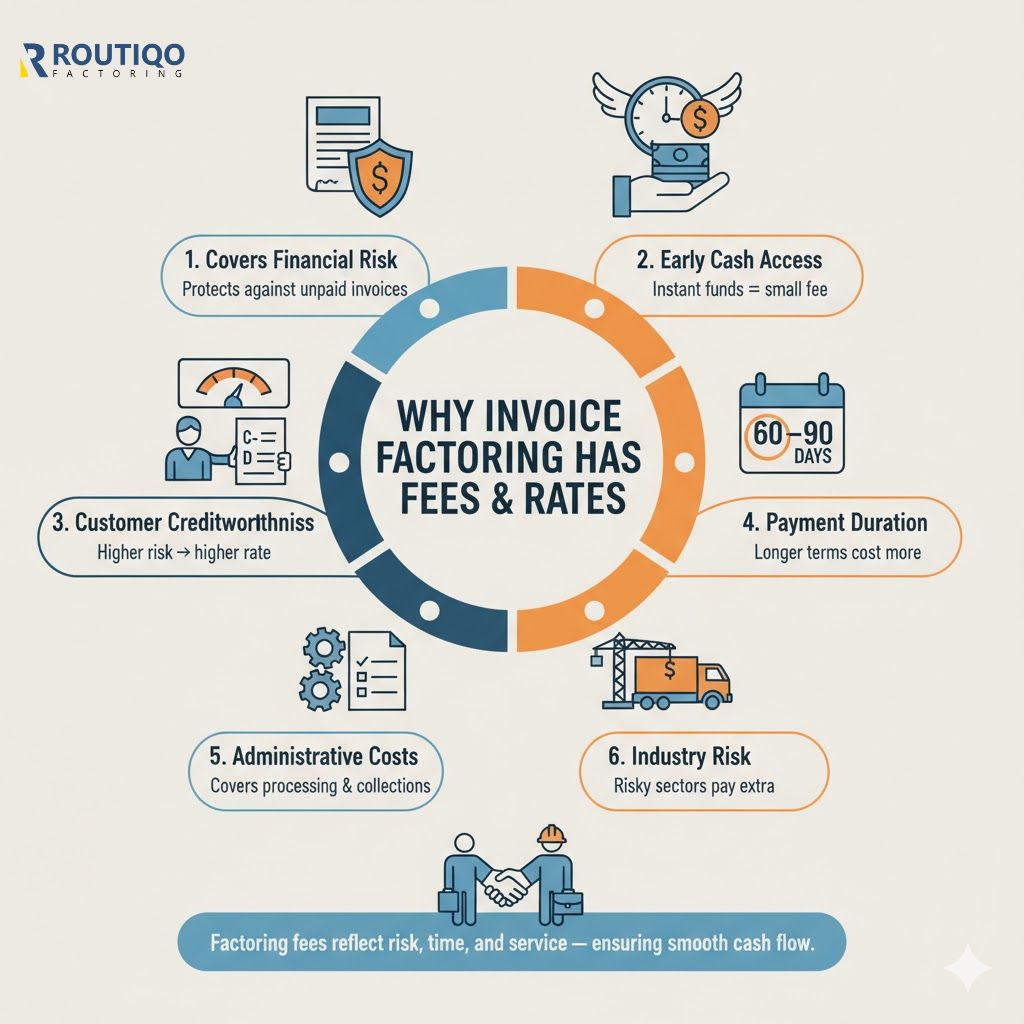
- Covers Financial Risk: Factoring companies charge fees to offset the risk of customer non-payment since they advance cash before the invoice is paid.
- Compensates for Early Cash Access: The rate reflects the cost of providing immediate liquidity, similar to short-term financing.
- Accounts for Customer Creditworthiness: Businesses with customers who have weaker credit histories face higher rates due to increased collection risk.
- Reflects Invoice Payment Duration: Longer payment terms (e.g., 60–90 days) increase holding time, so the factoring cost rises accordingly.
- Includes Administrative Costs: Fees cover back-office services such as invoice verification, collection, and payment tracking.
- Varies by Industry Risk: Industries with frequent disputes or delayed payments, like construction or logistics, are charged higher factoring rates.
What Are the Typical Factoring Rates?
Average Range of Factoring Rates
Most factoring companies charge rates that usually fall within a clear range depending on the type of business and risk level. Low-risk industries like manufacturing or wholesale often pay around 1% to 2%, while service-based sectors such as staffing or logistics average 2% to 3%.
High-risk industries, including construction or oil and gas, typically face higher rates between 4% and 5% due to longer payment terms and greater chances of delayed payments. In short, the more reliable your customers are with payments, the less you’ll pay in factoring costs.
Flat and Tiered Pricing Structures
Factoring companies usually apply two main pricing models, flat rates and tiered rates. A flat rate stays the same no matter how long your customer takes to pay; for example, if your rate is 2.5%, you pay that amount whether the invoice clears in 15 days or 45 days, making it simple and predictable for budgeting.
A tiered rate changes based on time and payment duration. You might pay 2% for the first 30 days, then an extra 1% every 15 days after that, which can be cost-effective if your clients pay quickly but becomes more expensive when payments are delayed.
The Role of Advance Rates
The advance rate determines how much of your invoice value you receive upfront, usually between 70% and 90%. A higher advance means you get more cash immediately, but it can slightly raise your overall factoring cost since the factoring company takes on more risk.
For instance, if you accept a 90% advance, your rate might climb from 2% to 3%. A business that only needs partial liquidity can often save by opting for a lower advance percentage.
How Payment Terms Affect Costs
Payment duration is one of the biggest pricing drivers. Invoices paid within 30 days usually attract rates between 1% and 2%, while those stretching to 60 or 90 days can reach 4% or more. The longer a factoring company waits to be reimbursed, the higher the fee it charges to cover that time.
Businesses with consistently long customer payment terms should focus on negotiating fixed or capped fees to prevent costs from escalating month after month.
Industry-Specific Rate Patterns
| Industry | Typical Rate Range (30 Days) | Average Advance Rate |
| Transportation & Freight | 1.5% – 3% | 85% – 95% |
| Manufacturing | 1% – 2.5% | 80% – 90% |
| Staffing & Payroll | 2% – 4% | 80% – 90% |
| Construction | 3% – 5% | 70% – 85% |
| Healthcare & Medical Billing | 2% – 4% | 75% – 90% |
Industries with quick, reliable payments — like transportation or manufacturing — usually get lower rates. Construction companies often pay more because invoices take longer to be settled.
A Simple Cost Example
Let’s say you factor a $50,000 invoice at a 3% rate with an 85% advance. You receive $42,500 upfront, and when your customer pays, the factor keeps 3% ($1,500) and releases the remaining balance ($6,000). Your total proceeds equal $48,500, meaning your cost is $1,500 for 30 days.
If the same invoice takes 60 days to pay and your rate increases to 5%, the cost rises to $2,500, reducing your total payout to $47,500. That difference shows how payment speed directly affects the overall cost.
Key Factors That Influence Factoring Rates
Several important factors influence how much a business pays for invoice factoring. Each one affects the level of risk for the factoring company and directly determines your overall rate.
Customer Creditworthiness
Factoring companies carefully review your customers’ payment history and credit strength before deciding on a rate. Clients with strong credit ratings and reliable payment records reduce the factor’s risk, which leads to lower factoring costs for your business.
Invoice Volume
A higher monthly invoice volume gives you better bargaining power with the factoring company. Consistent and large invoice volumes often earn a 0.5%–1% rate discount since they provide a steady flow of business for the factor.
Invoice Terms
The length of your invoice payment terms has a direct impact on your rate. Invoices paid within 30 days usually have lower fees, while those extending to 60 or 90 days cost more because the factor’s money remains tied up longer.
Industry Risk
Industries such as construction and oil and gas often face higher dispute and delay risks. To offset these risks, factoring companies increase rates by 1%–2%, making industry type a key pricing factor.
Type of Factoring
In recourse factoring, your business remains responsible if customers fail to pay, resulting in lower rates between 1% and 3%. In non-recourse factoring, the factor takes on the credit risk, which raises costs to around 3%–6%.
Business Stability
Businesses with consistent cash flow and a diverse customer base typically receive better factoring terms. A steady revenue pattern and low dependency on single clients signal lower risk, allowing the factor to offer more favorable rates.
How Are Factoring Fees Calculated?
The Basic Formula
Most factoring companies calculate their fee as a percentage of the total invoice value. The general formula looks like this:
Factoring Fee = Invoice Value × Factoring Rate × Time
For example, if you factor a $10,000 invoice at a 2% rate for 30 days, your fee will be $200. If the customer takes longer to pay, the cost increases based on how many additional days the factor holds the invoice.
Time-Based Rate Structure
The time your customer takes to pay has the biggest impact on your total fee.
- If your customer pays within 30 days, you’ll usually pay the base rate (for example, 2%).
- If payment takes 45 days, you might pay an extra 1% for that extra period.
- If it goes beyond 60 days, the rate can increase again, often by another 1%–1.5%.
This system incentivizes businesses with prompt payments and imposes higher charges for delayed payments.
The Role of Advance Rate
When you factor an invoice, you receive a portion of the amount upfront—usually between 70% and 90%. The remaining balance, called the reserve, is paid once your customer settles the invoice.
The higher your advance rate, the more money you get upfront, but the factoring company takes on greater risk. Because of this, higher advance rates often come with slightly higher factoring fees.
Example of Fee Calculation
Let’s take a simple example to see how factoring fees are calculated in practice.
- Invoice Value: $20,000
- Factoring Rate: 3% for 30 days
- Advance Rate: 85%
- Payment Time: 45 days
Here’s how it works:
- Initial fee for 30 days = $20,000 × 3% = $600
- Extra fee for additional 15 days (1%) = $200
- Total Fee = $800
You receive $17,000 upfront (85%), and after the customer pays, the factor sends the remaining $2,200 (after deducting $800 in fees).
Additional Fees to Watch For
Besides the main rate, some factoring companies include smaller service fees that add to the total cost.
- Setup or application fees: A one-time charge for account creation and credit checks.
- Wire or ACH fees: A small fee ($15–$50) for transferring funds to your account.
- Minimum volume fees: Applied if you don’t meet the required monthly invoice amount.
- Termination fees: Charged if you end the contract early.
These fees can seem small individually but may increase your total cost by 10%–20% if not considered in advance.
How to Reduce Invoice Factoring Rates and Fees?
Follow these six proven strategies to minimize factoring costs:
Improve Customer Credit Profiles
Work with creditworthy clients and maintain accurate payment records. Strong customer credit reduces your perceived risk and lowers rates.
Shorten Payment Terms
Switch customers from net 60 to net 30 billing. Shorter invoice durations decrease the factor’s exposure time and cost.
Increase Factoring Volume
Bundle more invoices into each factoring cycle. Larger monthly volume strengthens your negotiating position.
Compare Multiple Providers
Request quotes from at least three factoring companies. Compare not just rates but total costs—including hidden or tiered fees.
Choose Recourse Factoring
If you can absorb non-payment risk, choose recourse factoring. It costs 1%–2% less than non-recourse agreements.
Review Contracts Carefully
Ensure contracts exclude automatic renewals, high termination fees, or undisclosed “minimum usage” charges.
Final Thoughts
Invoice factoring is a practical financing solution for businesses seeking immediate liquidity. Understanding rates, fees, and influencing factors ensures informed decisions and prevents hidden cost surprises.
Evaluate offers using total cost, not just the discount rate. Compare contract terms, assess risk allocation, and project your effective annual cost.
When used strategically, factoring becomes a predictable cash-flow tool, not an expensive last resort.
Leave a Reply